


Artículo: What Is Acetate Fabric? How It's Made and How It Differs from Silk
What Is Acetate Fabric? How It's Made and How It Differs from Silk
Acetate is a man-made fibre of cellulose acetate, that is, chemically modified cellulose. The raw material comes from wood or cotton; the fibre itself is made in a factory. Acetate fabric has a soft sheen and a fluid drape much like silk, but it isn't silk, and in the EU its fibre has to be listed as “acetate”, never as “silk”. This guide covers how acetate is produced, where you're likely to come across it, how it differs from silk and polyester, and how to care for it.
What is acetate fabric?
Acetate fabric is made from acetate fibre, a textile fibre of cellulose acetate. To make the fibre, purified cellulose from wood pulp or from cotton linters, the short fibres left on cotton seeds, is treated with acetic acid and acetic anhydride. In this step, called acetylation, acetyl groups take the place of the hydrogen in the cellulose's hydroxyl groups. The cellulose acetate is then dry-spun into filaments.
How far the acetylation goes also determines what the fibre may be called. EU textile labelling law defines acetate as cellulose acetate fibre in which less than 92% but at least 74% of the hydroxyl groups are acetylated. Once at least 92% are acetylated, the fibre is triacetate. US rules also use 92% as the point from which the fibre may be called triacetate.
Is acetate natural or synthetic?
Neither, strictly speaking. Its raw material, cellulose, is natural, but the fibre is made chemically, so acetate counts as a man-made fibre. It differs from viscose in the process: viscose is regenerated cellulose, acetate chemically modified cellulose. It differs from polyester in the raw material: polyester is built entirely from chemical substances and contains no cellulose. Of the three, only polyester is synthetic in the strict sense.
A short history of acetate
Paul Schützenberger and Laurent Naudin discovered in Paris in 1865 that cellulose can be acetylated with acetic anhydride. Acetate only reached the market as a textile fibre after the First World War: in 1921 British Celanese, the company of the Swiss brothers Henri and Camille Dreyfus, began making acetate yarn in England and sold it as artificial silk, used among other things for inexpensive linings. Production in the United States started in 1924.
Properties of acetate
- Sheen and drape: acetate fabrics have a silk-like lustre, feel soft and hang fluidly.
- Moisture: the fibre takes up about 6 to 6.5% moisture relative to its dry weight. Triacetate takes up less, about 2.5 to 3.5%. For comparison, silk takes up about 11% and polyester 0.1 to 0.4%. Acetate garments dry quickly after washing.
- Strength: acetate is noticeably weaker wet than dry.
- Heat: acetate softens with heat and melts at about 230 °C (445 °F), and it's ironed only at a low temperature.
- Acetone: acetone dissolves acetate. The official EU test that labs use to measure the acetate share in a fibre blend relies on this: the acetate is dissolved out with acetone. Triacetate, on the other hand, doesn't dissolve in acetone.
What acetate is used for
Thanks to its sheen, acetate is still used for clothing linings. You'll also find it in blouses, dresses and lingerie, sometimes as satin. Satin is a weave, not a fibre, and can be woven from silk, acetate or viscose, among other fibres. In shops, though, satin is often woven from polyester or another synthetic fibre; what that means when you compare it with silk is covered in our guide to silk vs satin. Triacetate is used for taffeta, among other things.
Outside clothing, you'll come across cellulose acetate in at least two places. Bundles of cellulose acetate fibre are the main material in cigarette filters. And when a pair of glasses is sold with acetate frames, it's the same base material, used as a plastic instead of spun into fibre.
Acetate vs silk vs polyester
| Feature | Acetate | Silk | Polyester |
|---|---|---|---|
| Raw material | Cellulose from wood or cotton, chemically modified | Fibre from silk-secreting insects | Chemical substances, no cellulose |
| Fibre type | Man-made fibre from a natural polymer | Natural fibre | Synthetic fibre |
| Fibre moisture uptake | about 6 to 6.5% | about 11% | 0.1 to 0.4% |
| Ironing, as a rule | one dot, max. 110 °C (230 °F) | two dots, about 150 °C (300 °F) | two dots, about 150 °C (300 °F) |
| Acetone | dissolves the fibre | doesn't dissolve the fibre | doesn't dissolve the fibre |
Each fibre has its strengths. Acetate has a silk-like sheen, drapes softly and dries fast. Polyester is stronger and can take a hotter iron. Silk is a natural fibre and, of the three, takes up the most moisture. The ironing temperature for any particular item is always the one on its care label.
Acetate on the label
The fibre composition tells you whether a fabric is acetate. In the EU, only the fibre names listed in Regulation (EU) No 1007/2011 may be used in the fibre composition, and acetate appears there as “acetate”, the more heavily acetylated version as “triacetate”. In the US, the Federal Trade Commission's textile rules list acetate as a generic fibre name too. Under the EU rules, the name “silk” belongs to fibre obtained exclusively from silk-secreting insects, and on a label it may not be used for other fibres, whether on its own, as a root or as an adjective. So acetate is never listed as “silk” in a fibre composition, however much the fabric looks like silk. Words such as “silky”, “silk touch” or “satin finish” say nothing about the fibre; they describe how a fabric looks or feels.
You'll still hear the old name artificial silk, though. What sits behind artificial silk and how to tell it from real silk is explained in our guide on the subject. Feel and sheen are only hints: whether a fibre is really silk can't be settled for certain without a lab test, not even with the often-recommended burn test.
How to care for acetate
For any textile, the care label comes first: it sets the temperature, the wash cycle and how to dry. With acetate, three further points apply.
- No acetone: keep nail polish remover away from acetate and triacetate fabrics, because acetone dissolves acetate and can damage triacetate. Take care with spot removers as well, since some other organic solvents dissolve acetate.
- Low heat: the usual advice is to iron acetate only at the lowest setting, slightly damp and on the reverse side, to keep its sheen.
- Gentle when wet: acetate is weaker wet, and creases that form while it's wet tend to stay in the fabric. So handle wet acetate gently.
Hand wash, machine wash or dry cleaning: the label decides. Silk has rules of its own; our step-by-step guide on how to wash silk walks you through them.
Silk at RENESSY
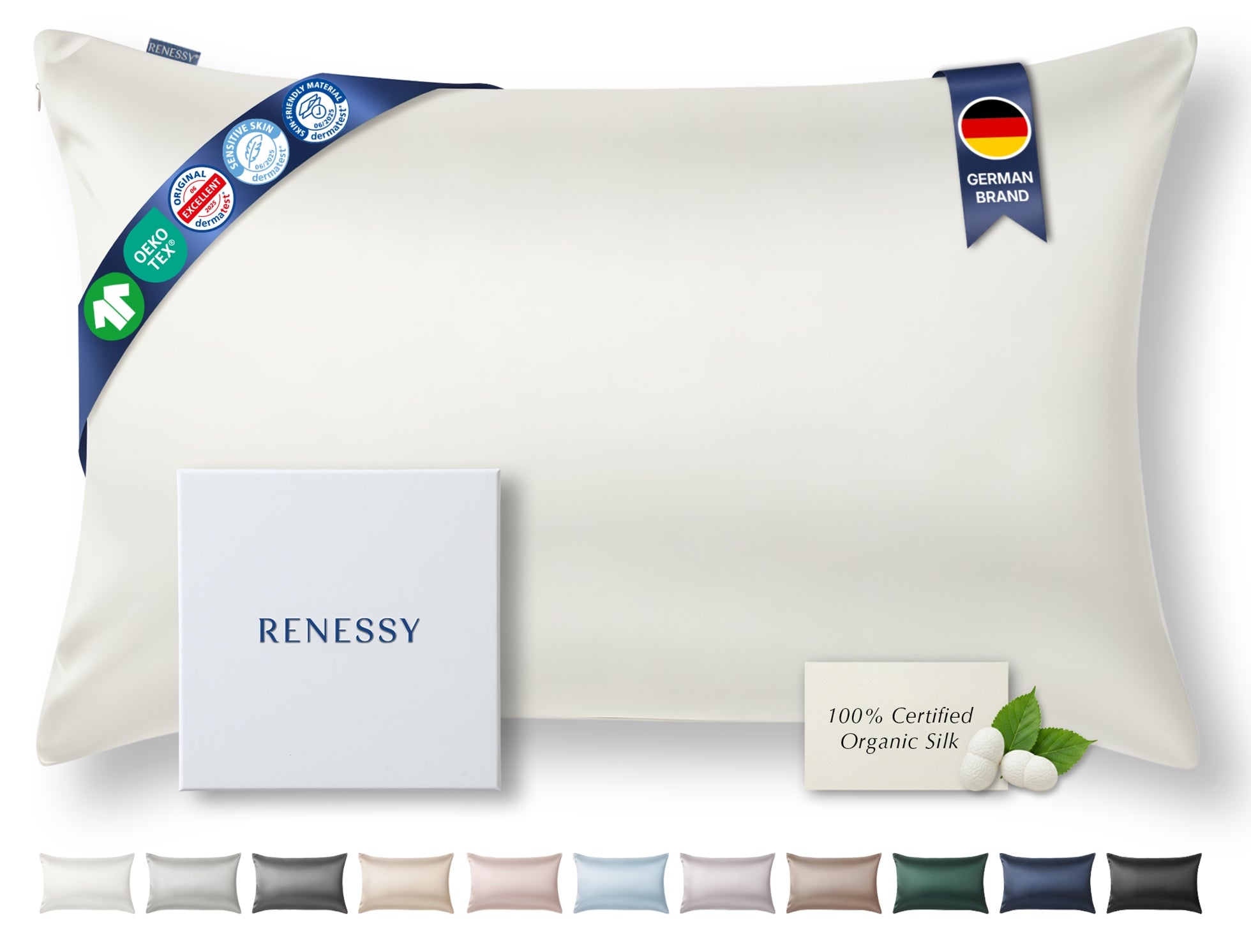
The silk pillowcases from RENESSY aren't made of acetate but of 100% organic mulberry silk, 22 momme, Grade 6A, on both faces. The silk is GOTS certified. The pillowcases carry the OEKO-TEX MADE IN GREEN label, and the label ID M27MNB1V9 can be checked on the OEKO-TEX website. The pillowcases carry the Dermatest 5-Star seal and the Dermatest Sensitive Skin seal, dermatologically tested for sensitive skin. What sets mulberry silk apart from other silks is covered in our guide to mulberry silk.
Frequently asked questions about acetate
Is acetate a natural fibre or synthetic?
Neither, strictly speaking: acetate is a man-made fibre of cellulose acetate. Its raw material, cellulose, comes from wood or cotton, but the fibre itself is made chemically, so, unlike polyester, it isn't a synthetic fibre in the strict sense.
Is acetate silk?
No. Acetate is a man-made fibre from cellulose; silk is a natural fibre obtained from silk-secreting insects. In the EU, acetate fibre may not be called silk in a fibre composition, however similar it looks.
What's the difference between acetate and polyester?
Acetate is made from cellulose and polyester entirely from chemical substances; acetate takes up more moisture and dissolves in acetone, while polyester is stronger and can be ironed hotter.
Can you wash acetate?
Yes, acetate can be washed if its care label allows it, and in the way the label specifies: keep acetone away from it, iron it only at the lowest setting and handle it gently when wet, because the fibre is weaker in that state.
What's the difference between acetate and triacetate?
The difference is the degree of acetylation: in acetate less than 92% but at least 74% of the hydroxyl groups are acetylated, in triacetate at least 92%, and triacetate takes up less moisture and, unlike acetate, doesn't dissolve in acetone.
Sources
- Regulation (EU) No 1007/2011 on textile fibre names, consolidated version: EUR-Lex
- US Code of Federal Regulations, 16 CFR 303.7, generic names and definitions for manufactured fibres: eCFR
- Encyclopaedia Britannica: Cellulose acetate
- Museum of Fine Arts Boston, CAMEO: Acetate fiber, Triacetate fiber, Silk, Polyester fiber
- German cosmetics and detergents association (IKW): Care symbols leaflet (German)
- University of Georgia Extension: Removing fingernail polish stains
- Encyclopedia.com: Celanese Corporation
- Wikipedia (German): Celluloseacetat
- Victoria and Albert Museum: Spectacle frames in cellulose acetate