


Why Won't My Hair Hold a Curl? Causes and Fixes
Why won't my hair hold a curl? A curl from a curling iron, a wand or hot rollers is a set: a temporary shape the hair keeps once it has been fixed in it. It drops when you let go of it before it has cooled, when moisture from humid air or damp hair loosens it, or when the hair is too heavy or, as stylists find, too slippery to keep the shape. To fix it, curl hair that is completely dry in small sections, let each curl cool before you touch it, and add a product that gives some hold. Natural curls that lose their definition are a different problem, which our guide to frizzy curly hair covers.
How a curl sets, and why it lets go
A curling iron is a heated metal barrel you wrap a section of hair around; a wand is the same barrel without the clamp; hot rollers are heated cylinders that the hair is wound onto. Heat makes the hair soft enough to bend around the barrel or roller, the new shape is fixed as the hair cools, and water or humid air can loosen it again. A 2003 study of human hair fibres put the fact that hair can be curled at all down to how its mechanical behaviour depends on time, temperature and humidity, the water vapour held in the air.
Water changes how easily hair softens. A 2006 laboratory study measured the glass transition of human hair, the point at which it turns from stiff to soft, and found that this point depends on how much water the hair contains. A 2017 study on goat hair showed the whole cycle: heat fixed a temporary curl better than the other treatments tested, the hair was left to cool before the curl was examined, and water brought it back to its original shape. Hair that dries while it is held in a shape sets in a similar way, as our guide on how to avoid bed head explains.
Why your hair won't hold a curl
Several of the fixes below come from styling practice rather than from studies: we found no research on cooling times, product residue, section size or hair washed the day before, so those tips are given as what stylists advise.
You let go before the curl cooled
A curl is still soft while it is warm, so brushing, shaking or pulling it then bends it out of shape before it has been fixed. What helps: stylists often advise holding each curl in your palm, or pinning it with a clip, until it feels cool.
Moisture from humid air or damp hair
Hair takes up some of the water vapour in humid air: in a 2007 laboratory test, human hair fibres took up more water and became less stiff as the air grew more humid. Since water softens hair, it also loosens a set, which is why curls tend to drop sooner on a humid day, in a steamy bathroom or when the hair is still damp underneath as you curl it. Damage and porosity also change how readily hair takes up water, which our hair porosity test helps you check.
Never use a curling iron on damp or wet hair: in a 2004 study of curling iron treatment, heat applied to wet hair turned water inside the fibre into steam, which made the cuticle, the outer layer of the hair, bubble and buckle. What helps: dry your hair completely, roots included, before you curl it.
Hair that is very clean, slippery or weighed down
Stylists often find that freshly washed, well conditioned hair is too smooth for a curl to grip, and that heavy creams, oils or old product residue weigh curls down. What helps: stylists often advise curling hair washed the day before, a light setting product rather than a heavy one, and a clarifying shampoo now and then.
Sections too big for the barrel
Stylists often advise small sections, reasoning that a thick section wrapped around the barrel does not heat evenly all the way through. What helps: sections thin enough to wrap flat around the barrel.
Fine or long hair
A 1995 theoretical model of the hair fibre found that thickness has the dominant effect on how much a hair resists bending. Fine strands therefore bend easily and have little stiffness of their own to hold a curl up. Fine strands are not the same as having fewer hairs, which is a matter of hair density. A 2015 mechanical model of curling hair on rollers named gravity among the factors that affect how well a curl is retained. For natural curls, weight is one reason thin curly hair can fall flat. If your hair won't hold a curl however carefully you section it, fine or long hair may be part of the reason; stylists often suggest a setting product and a narrower barrel for fine hair.
The iron is turned up to compensate
Turning the iron up does less for hold than you might expect. A 2011 study that tested curls across a range of curling iron temperatures reported that higher heat did surprisingly little to improve how well hair held its styled curve, while the onset of damage depended strongly on temperature. What helps: use the lowest heat that gives you a curl.
How to make curls last
To make curls from an iron or hot rollers last, curl hair that is completely dry in small sections, hold or pin each curl until it is cool, and use a product that gives hold before curling and hairspray after.
- Dry hair, roots included, before an iron goes anywhere near it.
- Small sections and a light setting product, as stylists advise.
- The lowest heat that gives you a curl.
- Hold or pin each curl until it has cooled, then leave it alone.
- Hairspray once the curls are cool. A 2010 study of styling products describes hairspray as joining neighbouring hairs at individual spots.
- Separate the cooled curls with your fingers rather than a brush, which stylists say loosens them into a softer shape.
Hairspray does not make a curl immune to humid air, and a 2001 study found that a hairspray's performance depends on its formula and on whether the hair is bleached or untreated. If you would rather set curls without heat, overnight while you sleep, our guide to heatless curls covers the method. For one heatless method, wrapping damp hair around a long sock, see our guide to sock curls.
Keeping curls overnight
Sleeping flat on your curls tends to press them out of shape. Stylists often advise gathering them loosely on top of your head. A bonnet holds gathered hair in one place for the night. A silk pillowcase changes the friction your hair meets, not the way it sets. Sweat and humid air at night still work on a set, so expect to touch up a few curls in the morning.
What no routine can do
One honest limit: nothing switches humidity off. Any curl you set is temporary, and on naturally straight hair it goes as soon as the hair gets properly wet again. Hair itself changes over time: a 2007 study of hair and ageing linked the loss of volume and bounce some women notice with age partly to changes inside the hair. A routine that suited your hair years ago may need adjusting now.
What our silk pillowcases are made of
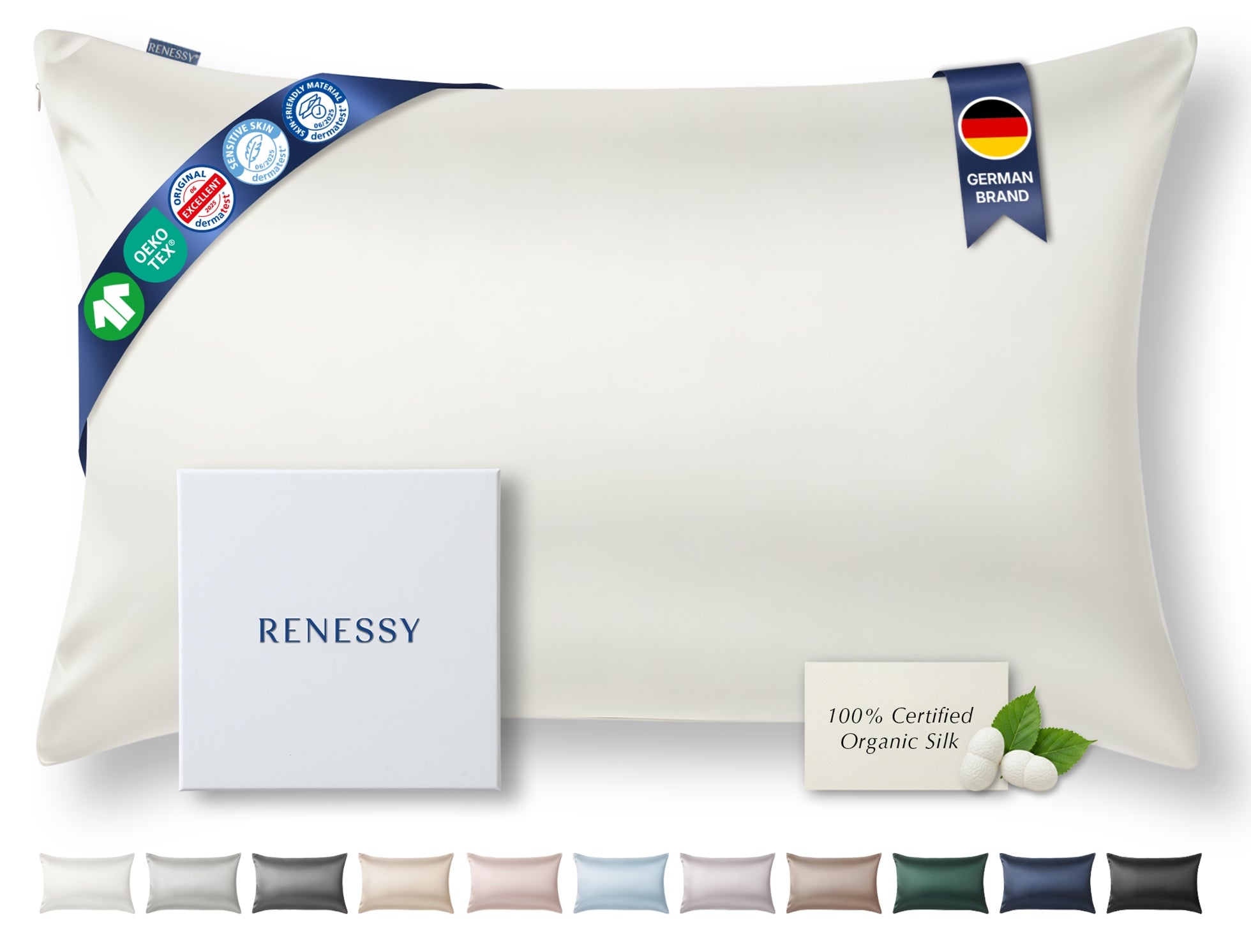
The RENESSY silk pillowcases use 100% organic mulberry silk with a weight of 22 momme, and both faces of each case are silk. Mulberry silk comes from silkworms raised on the leaves of the mulberry tree, and momme measures the weight of silk fabric. The raw silk is rated grade 6A, a raw-silk grade that assesses several qualities of the thread together. GOTS, the Global Organic Textile Standard, certifies textiles made from organically grown fibres. The silk is GOTS certified. OEKO-TEX MADE IN GREEN is a label for textiles tested for harmful substances and made in traceable, certified production. The pillowcases carry the OEKO-TEX MADE IN GREEN label, and the label ID M27MNB1V9 can be checked on the OEKO-TEX website. The pillowcases carry the Dermatest 5-Star seal and the Dermatest Sensitive Skin seal, dermatologically tested for sensitive skin. A hidden YKK zip closes each case.
Frequently asked questions
Why does my hair go straight after I curl it?
Hair goes straight after you curl it when the curl is disturbed before it has cooled, when moisture from damp hair or humid air loosens the set, or when the hair is too fine, too heavy or, as stylists find, too slippery to keep the shape.
Why do my curls hold better on second-day hair?
Many stylists find that curls hold better on hair washed the day before, because freshly washed hair is smoother and gives a curl less grip; this is salon experience, not a tested result.
Does a hotter curling iron give a better hold?
A hotter curling iron does not reliably give a better hold: a 2011 study reported that higher temperatures did surprisingly little for how well hair held its curl, while the onset of damage depended strongly on temperature.
Does hairspray help curls hold?
Stylists use hairspray to help curls hold, and a 2010 study of styling products describes it as joining neighbouring hairs at individual spots; humid air still works against it.
Sources
- Gao T. Evaluation of hair humidity resistance/moisturization from hair elasticity. Journal of Cosmetic Science. 2007. PMID 17728940
- Harper D, Qi JC, Kaplan P. Thermal styling: efficacy, convenience, damage tradeoffs. Journal of Cosmetic Science. 2011. PMID 21635843
- Hoessel P, Riemann S, Knebl R, Schroeder J, Schuh G, Castillo C. Assessment of styling performance in hair gels and hair sprays by means of a new two-point stiffness test. Journal of Cosmetic Science. 2010. PMID 20939974
- Jachowicz J, Yao K. Dynamic hairspray analysis. II. Effect of polymer, hair type, and solvent composition. Journal of Cosmetic Science. 2001. PMID 11567208
- Mamada A, Nakamura K. A study of the volume and bounce decrease in hair with aging using bending elasticity measurements. Journal of Cosmetic Science. 2007. PMID 17938824
- Ruetsch SB, Kamath YK. Effects of thermal treatments with a curling iron on hair fiber. Journal of Cosmetic Science. 2004. PMID 15037918
- Swift JA. Some simple theoretical considerations on the bending stiffness of human hair. International Journal of Cosmetic Science. 1995. doi:10.1111/j.1467-2494.1995.tb00129.x
- Wortmann FJ, Stapels M, Elliott R, Chandra L. The effect of water on the glass transition of human hair. Biopolymers. 2006. doi:10.1002/bip.20429
- Xiao H, Chen X. A mechanical model of overnight hair curling. The European Physical Journal E, Soft Matter. 2015. doi:10.1140/epje/i2015-15095-2
- Xiao X, Hu J, Gui X, Qian K. Shape Memory Investigation of α-Keratin Fibers as Multi-Coupled Stimuli of Responsive Smart Materials. Polymers. 2017. doi:10.3390/polym9030087
- Zuidema P, Govaert LE, Baaijens FP, Ackermans PA, Asvadi S. The influence of humidity on the viscoelastic behaviour of human hair. Biorheology. 2003. PMID 12775909