


Artículo: Protein Overload Hair: Signs, Causes and What to Do
Protein Overload Hair: Signs, Causes and What to Do
Protein overload hair is the name haircare communities give to hair that turns stiff, rough and brittle after a run of protein-rich products. The feel is real, but we have not found a study of protein overload itself, and dryness, damage and build-up cause the same symptoms. Most guides suggest pausing protein, one clarifying wash and more conditioning; if the stiffness eases, protein may have played a part, although the wash and the conditioning deal with build-up and dryness at the same time.
What is protein overload in hair?
Protein overload is a haircare community term for stiff, straw-like hair that snaps easily after too many protein products. Guides explain it in two ways that do not fit together: protein building up on the surface, or hair holding too much protein and too little moisture. Neither comes with a source.
We have not found a study showing that protein overload exists as a hair condition, nor one showing that protein products make hair feel stiff or brittle in everyday use, although you will read both claims. In PubMed and Europe PMC the term turns up in unrelated medical and biological research, for example on kidney disease. The symptoms are still real, and the sections below cover their better documented causes.
Hydrolysed protein is protein broken down into smaller fragments, called peptides, or into amino acids. In cosmetics it is classed as a conditioning ingredient: a 2018 safety assessment lists hydrolysed wheat protein as a skin and hair conditioning agent, and a 2023 review names protein-based conditioners as one of three main conditioner types.
Where protein ends up depends on fragment size. In a 2021 lab study on chemically straightened (relaxed) textured hair fibres, small and mid-sized keratin fragments reached deep into the cortex, the main body of the hair, while the largest stayed mostly on the surface. The 2023 review and a 2026 lab study on damaged hair describe the same split: small fragments get into the hair, large ones stay mainly at the cuticle, the outer layer. That supports the surface part of the build-up idea, but no study we found measured whether a surface layer of protein makes hair feel stiff.
Stiffer is not the same as more brittle
Young's modulus measures how strongly a material resists being stretched; a stiff material has a high modulus. In the 2021 study, mid-sized and large keratin fragments raised the modulus of the relaxed hair fibres, and the treated fibres broke less often at 20% and 80% relative humidity: in the lab, hair treated with protein got stiffer without getting more breakable. The study measured single fibres, not how hair feels, but it suggests that “stiff and brittle” may describe two different things.
Signs of protein overload
Guides describe the signs much the same way:
- Hair feels stiff and rough.
- The lengths and ends feel straw-like.
- A strand snaps when stretched instead of giving a little.
- Hair looks dull, with wiry frizz.
- Curls lose their shape.
Dry and damaged hair show the same signs, so the best clue is timing: did the symptoms start after you added protein products? Our guide on why your hair won't hold a curl covers curls set with heat.
Protein or moisture: how guides tell them apart
If your hair turned stiff after a run of protein products, most guides say it needs less protein and more conditioning; if it feels rough and dry with no change in products, they point to dryness. The table shows the usual guide reading of protein vs moisture, not a measured scale.
| Sign | Often read as too much protein | Often read as too little moisture | Often read as too much moisture |
|---|---|---|---|
| Feel | Stiff, rough, straw-like | Rough, straw-like, hard to comb | Soft and mushy |
| When stretched | Snaps with very little stretch | Can also snap; guides give no distinct reading | Stretches a long way, then snaps or does not spring back |
Stiffness is not only a protein sign: hair holding less water is stiffer too, as the findings below show.
The stretch test is a common at-home check: you stretch a single strand gently and watch it. Guides read a quick snap as too much protein and a long stretch as too much moisture, but we have not found a study showing that the test can tell too much protein apart from dryness or from too much moisture.
The same strand also changes from day to day. A 2022 study measured stiffness (Young's modulus) at about 2 GPa for wet hair and about 4 GPa under standard test conditions, so wet hair is roughly half as stiff as dry hair. A 2007 study found that hair gets steadily less stiff as air humidity rises from 50% to 80%; it calls this elasticity, but means stiffness, not stretch. So a strand reads differently wet or dry, on a humid or a dry day.
To make the test fairer, test in the same state each time and compare strands from different parts of your head.
Rule out the look-alikes first
Check these causes of stiff hair that snaps before you blame protein:
- Dry air. In the 2007 study, hair got steadily stiffer as air humidity fell from 80% to 50%, so drier air alone can change how stiff your hair is.
- Bleaching, colouring and heat. Chemical treatments and hot tools can leave hair rough and prone to snapping; our guide to damaged curly hair covers what to stop first. How that kind of damage looks on any hair type is set out in our guide to what damaged hair looks like.
- Build-up from styling products, dry shampoo or hard-water minerals. Guides suggest a clarifying shampoo for product build-up and, for mineral build-up, a shampoo labelled for hard water. Our guide to shiny hair covers clarifying in more detail.
- Too little conditioner. Hair that rarely gets conditioner feels rough and straw-like too; our guide to dry hair sets out a routine.
How to fix protein overload in hair
Here, “fixing” protein overload means clearing build-up and adjusting your care; it does not permanently repair the hair strand. A split or snapped strand cannot be restored: care products can only hold a split together or smooth it down for a while, and the lasting fix is to cut it off. To fix protein overload, most guides suggest pausing products that list protein, doing one clarifying wash, conditioning the lengths and then reintroducing protein products one at a time.
- Pause products that list protein. On the ingredient list, look for hydrolysed keratin, hydrolysed wheat protein, hydrolysed collagen and amino acids; labels often spell it “hydrolyzed”. Amino acids are protein building blocks rather than whole proteins, but guides list them too.
- Do one clarifying wash. Clarifying shampoos are stronger than everyday ones, so use them only as often as you need to.
- Condition the lengths and ends with conditioner or a moisturising mask.
- Reintroduce protein slowly. One product at a time helps show which one, if any, your hair reacts to.
If nothing changes after you pause protein, go back to the look-alikes above, especially dry air, damage and hard-water minerals.
Which hair is more prone to protein overload?
No study we found shows which hair is more prone to protein overload, and guides contradict each other: some say low porosity hair is, others curly or high porosity hair, and neither side cites a study. What is sourced is narrower: a 2015 review reports that more protein was deposited on chemically treated hair, especially bleached hair. Our guide to the hair porosity test repeats one side: several guides say that low porosity hair can feel stiff with too much protein.
Brittle hair at night
Brittle hair breaks more easily under everyday rubbing, and at night hair moves against the pillowcase with every turn. Our other guides suggest a loose braid or bun at night rather than a tight style. On friction, silk usually has the edge: its smooth, dense surface creates less friction against hair than a cotton weave does. A pillowcase does not repair hair that is already damaged. Our comparison of cotton vs silk pillowcases covers the other differences between the two fabrics.
What we could not find
We found no peer-reviewed study of protein overload and none that validates the home stretch test. We also left out the fixed mask times and waiting periods some guides give, since no source we found ties them to protein overload. Care makes dry hair more supple and easier to comb, but it does not permanently repair it.
What our silk pillowcases are made of
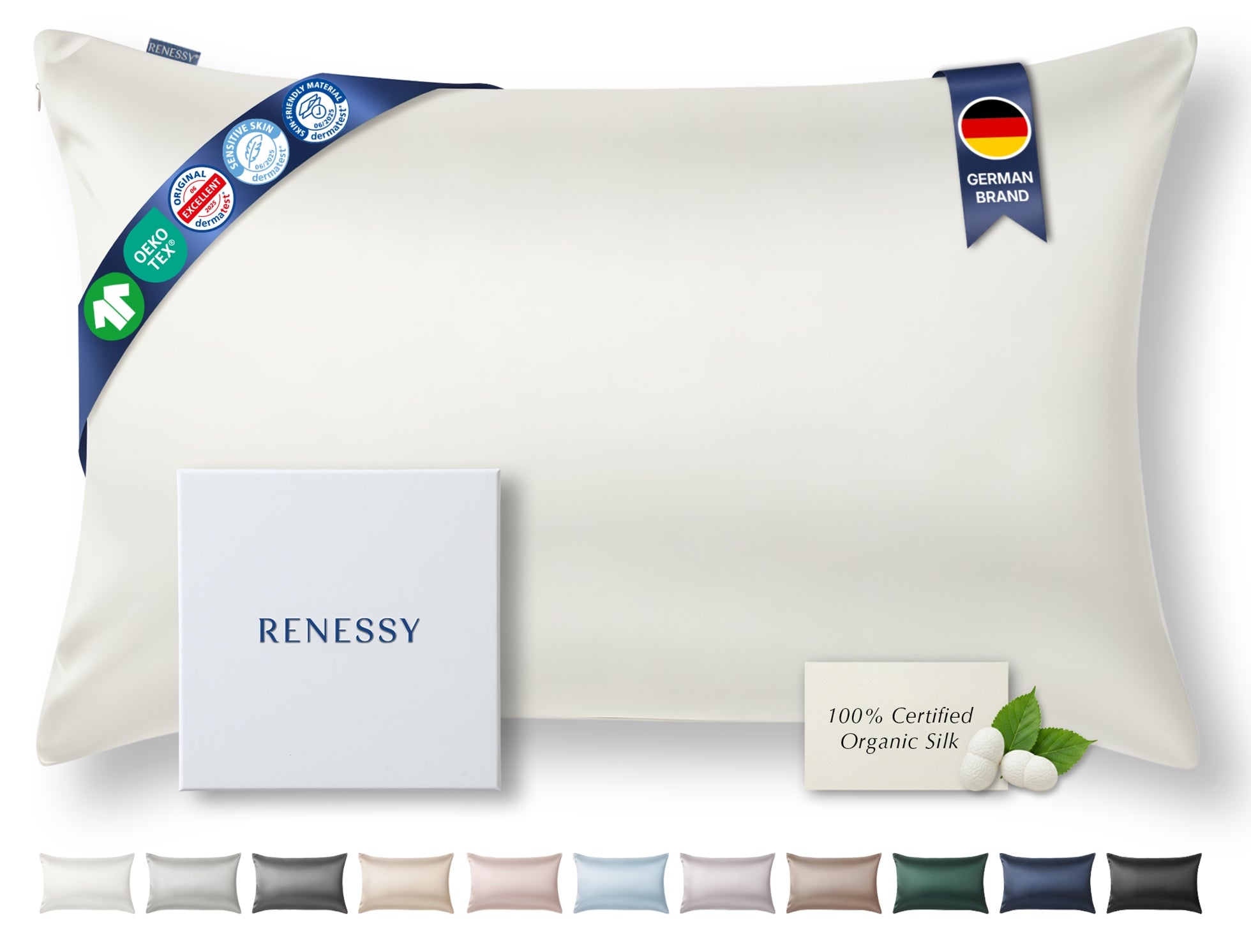
The RENESSY silk pillowcases use 100% organic mulberry silk with a weight of 22 momme, and both faces of each case are silk. Mulberry silk comes from silkworms raised on the leaves of the mulberry tree, and momme measures the weight of silk fabric. The raw silk is rated grade 6A, a raw-silk grade that assesses several qualities of the thread together. GOTS, the Global Organic Textile Standard, certifies textiles made from organically grown fibres. The silk is GOTS certified. OEKO-TEX MADE IN GREEN is a label for textiles tested for harmful substances and made in traceable, certified production. The pillowcases carry the OEKO-TEX MADE IN GREEN label, and the label ID M27MNB1V9 can be checked on the OEKO-TEX website. The pillowcases carry the Dermatest 5-Star seal and the Dermatest Sensitive Skin seal, dermatologically tested for sensitive skin. A hidden YKK zip closes each case.
Frequently asked questions
Does my hair need protein or moisture?
Whether your hair needs protein or moisture is hard to tell from feel alone, since guides blame rough, straw-like hair on both too much protein and too little moisture; if the roughness began after you added protein products, most guides suggest pausing them and conditioning first.
Is protein overload real?
The symptoms people call protein overload are real, but we have not found a study showing that too much protein is their cause.
Is the stretch test for protein overload accurate?
The stretch test is a common at-home check, but we have not found a study showing that it can tell too much protein apart from dryness or from too much moisture. Wet hair is roughly half as stiff as dry hair, so test in the same state each time.
Is curly hair more prone to protein overload?
We have not found a study showing that curly hair is more prone to protein overload; the sourced finding is that more protein was deposited on bleached and chemically treated hair.
Sources
- Burnett C, Bergfeld WF, Belsito DV, et al. Safety Assessment of Hydrolyzed Wheat Protein and Hydrolyzed Wheat Gluten as Used in Cosmetics. International Journal of Toxicology. 2018;37(1 Suppl):55S-66S. doi:10.1177/1091581818776013
- Carvalho JP, Costa AF, Gonçalves F, et al. Interaction of polypeptides with hair in different reducing environments. International Journal of Biological Macromolecules. 2026;340(Pt 1):150107. doi:10.1016/j.ijbiomac.2026.150107
- Fernandes C, Medronho B, Alves L, Rasteiro MG. On Hair Care Physicochemistry: From Structure and Degradation to Novel Biobased Conditioning Agents. Polymers. 2023;15(3):608. doi:10.3390/polym15030608
- Gao T. Evaluation of hair humidity resistance/moisturization from hair elasticity. Journal of Cosmetic Science. 2007;58(4):393-404. PMID 17728940
- Gavazzoni Dias MF. Hair cosmetics: an overview. International Journal of Trichology. 2015;7(1):2-15. doi:10.4103/0974-7753.153450
- Malinauskyte E, Shrestha R, Cornwell PA, et al. Penetration of different molecular weight hydrolysed keratins into hair fibres and their effects on the physical properties of textured hair. International Journal of Cosmetic Science. 2021;43(1):26-37. doi:10.1111/ics.12663
- Wortmann FJ, Quadflieg JM, Wortmann G. Comparing hair tensile testing in the wet and the dry state: Possibilities and limitations for detecting changes of hair properties due to chemical and physical treatments. International Journal of Cosmetic Science. 2022;44(4):421-430. doi:10.1111/ics.12796