


Article: Can You Wear a Bonnet With Wet Hair? How Dry Is Dry Enough
Can You Wear a Bonnet With Wet Hair? How Dry Is Dry Enough
Can you wear a bonnet with wet hair? Not while it is still dripping. Our rule of thumb: once your hair is towel-dry, meaning it no longer drips and gives up no more water when you squeeze it, a bonnet is fine, even if the hair still feels slightly damp. The reason to wait that we can source is the hair itself: wet hair is at its most fragile, and we would expect a closed cap to keep it wet for longer. We found no study linking a damp night under a bonnet to fungus or dandruff. Below: how dry is dry enough, how to get there on a short evening, what is and is not known about your scalp, and how to look after the bonnet afterwards.
Can you wear a bonnet with wet hair?
Not straight out of the shower. Hair takes up water and swells, mostly in width rather than length. In lab tests, wet hair stretches further before it gives, snags more easily and breaks under a lower load than dry hair, because water softens the fibre. That is a reversible state rather than damage in itself, but it is the state in which rubbing and pulling do the most harm.
A bonnet does not change that state, and it does not speed up drying either. We would expect a closed cap to hold moisture in, and a densely woven silk fabric takes up less water than an absorbent cotton one, so more of the water stays in the hair. Put on over dripping hair, a bonnet is likely to keep it in its most fragile state for longer. What happens to hair that goes to bed wet night after night is covered in our guide to sleeping with wet hair.
How dry is dry enough?
Towel-dry is the threshold we use: the hair has stopped dripping and gives up no more water when you squeeze a section. For a bonnet, check the roots as well: they should not feel wet against your fingers. The hair can still feel cool and slightly damp, and that is fine. If water runs out when you squeeze, it is too early.
You will see percentages online, such as 70, 80 or 90 per cent dry. We found no study behind any of them, and no study that tested bonnets on wet hair at all. The squeeze test is more useful than a number anyway, and how long hair takes to pass it varies from head to head, as our wet-hair guide explains.
Leave-in conditioner or styling cream does not change the rule. Slightly damp hair with product in it can go under a bonnet; hair that still drips should wait.
Getting there on a short evening
- Squeeze, then blot. Press the water out with a microfibre towel or an old cotton T-shirt rather than rubbing. The American Academy of Dermatology advises wrapping hair in a towel or T-shirt to absorb the water, because roughly rubbing hair dry can damage it.
- Dry the roots first, on a cool or low setting. Keep the dryer moving and hold it some distance from your head. In one lab study, hair dried with a dryer held 15 cm away and kept moving showed less damage over repeated washes than hair left to dry naturally; the authors called for more research. Start with the roots because that is where a bonnet is likely to hold moisture against the scalp.
- Give the bonnet a shape to hold. Gather the lengths into a high bun, a pineapple (curls tied up loosely on the crown) or a couple of soft braids.
- Keep the style underneath loose: dermatologists link sustained tension from tight styles to damage at the hairline over time. The bonnet's band only needs to be as firm as it takes to stay on.
What about your scalp?
This is where most pages on sleeping with wet hair in a bonnet warn about fungus, bacteria and smell. We found no study that looked at a damp scalp under a bonnet or sleep cap, so none of those warnings rests on research we could find.
What dermatology sources do say about dandruff and seborrhoeic dermatitis points elsewhere. Both are linked to a yeast that lives on most people's skin and feeds on scalp oil, together with how susceptible a person is, and neither is caused by poor hygiene. The American Academy of Dermatology describes seborrhoeic dermatitis as often easing in warm, humid weather and flaring when cold, dry weather returns, and the NHS names cold weather as something that can make dandruff worse. Warmth, sweat and covered skin are named in dermatology reviews as factors that favour the same yeast in a different condition, a folliculitis mostly on the chest and back; that evidence is neither a scalp study nor a study of wet hair.
The practical side is simpler. A bonnet over damp roots is likely to keep them damp against the scalp, which can leave them feeling clammy or looking flat by morning, and is one more reason to dry them first. Persistent itching, flaking or red patches are worth taking to a doctor; no bonnet, fabric or drying routine treats a scalp condition.
Curls, braids and wash-and-go nights
Curly routines are the main case where going to bed with damp hair is deliberate. Wash-and-go styles, refreshed curls and new braids or twists often go to bed damp with leave-in or gel in them, and the bonnet's job is to keep them gathered and off the pillow. The rule is the same as above: slightly damp with product is fine, dripping is not. Leave the bonnet off until the curls feel no more than slightly damp.
Reports differ on what happens next. Some people with curls find that a set which finishes drying under a bonnet holds its definition into the next day; others find their curls frizzier or flatter by morning. How it goes depends on the hair and the routine, and what we have are people's accounts; we found no study that measured it. Wear curls loosely, in a pineapple or soft twists, rather than pulled tight, and choose a bonnet with room for the volume. The full routine, including what to do with damp curls at bedtime, is in our guide on how to sleep with curly hair.
Which bonnet for damp hair?
Silk and satin are not two versions of the same thing: silk names a fibre and satin names a weave, which can be made from silk or from polyester. The differences are laid out in our silk vs satin bonnet comparison. For damp hair, two points matter more than the label.
The first is the surface. A smooth, densely woven fabric is meant to let hair slide rather than catch as you turn, which counts for more when the hair is damp, since wet hair snags more easily. That is a property of the fabric's surface and weave, not a ranking of fibres; we found no study that measured it on damp hair. No bonnet fabric dries hair, though, as explained above, and any closed cap is likely to slow drying, which is why the threshold above applies whatever the bonnet is made of.
The second is the fit. Damp hair, and curls in particular, calls for a bonnet with genuine room, and the band should be only as firm as it needs to be to stay on. What to look for in fit, closure and fabric weight is covered in our guide to the best silk bonnet for sleeping, and how to put it on, step by step, in our guide on how to wear a bonnet.
Looking after the bonnet after a damp night
A bonnet worn over damp hair takes up some of that moisture, and silk should not be put away damp. Wash it as the care label says, and more often if you regularly wear it over damp hair or with product; the general rules for silk, from temperature to drying, are in our guide on how to wash silk.
Between washes, turn it inside out in the morning and leave it open to the air over a chair back rather than folding it into a drawer. Conservation guidance links mould on textiles, silk included, to damp conditions and stagnant air, so what matters is not letting a damp bonnet sit folded and unaired. We found no study on mould in a bonnet after a damp night.
Silk bonnets at RENESSY
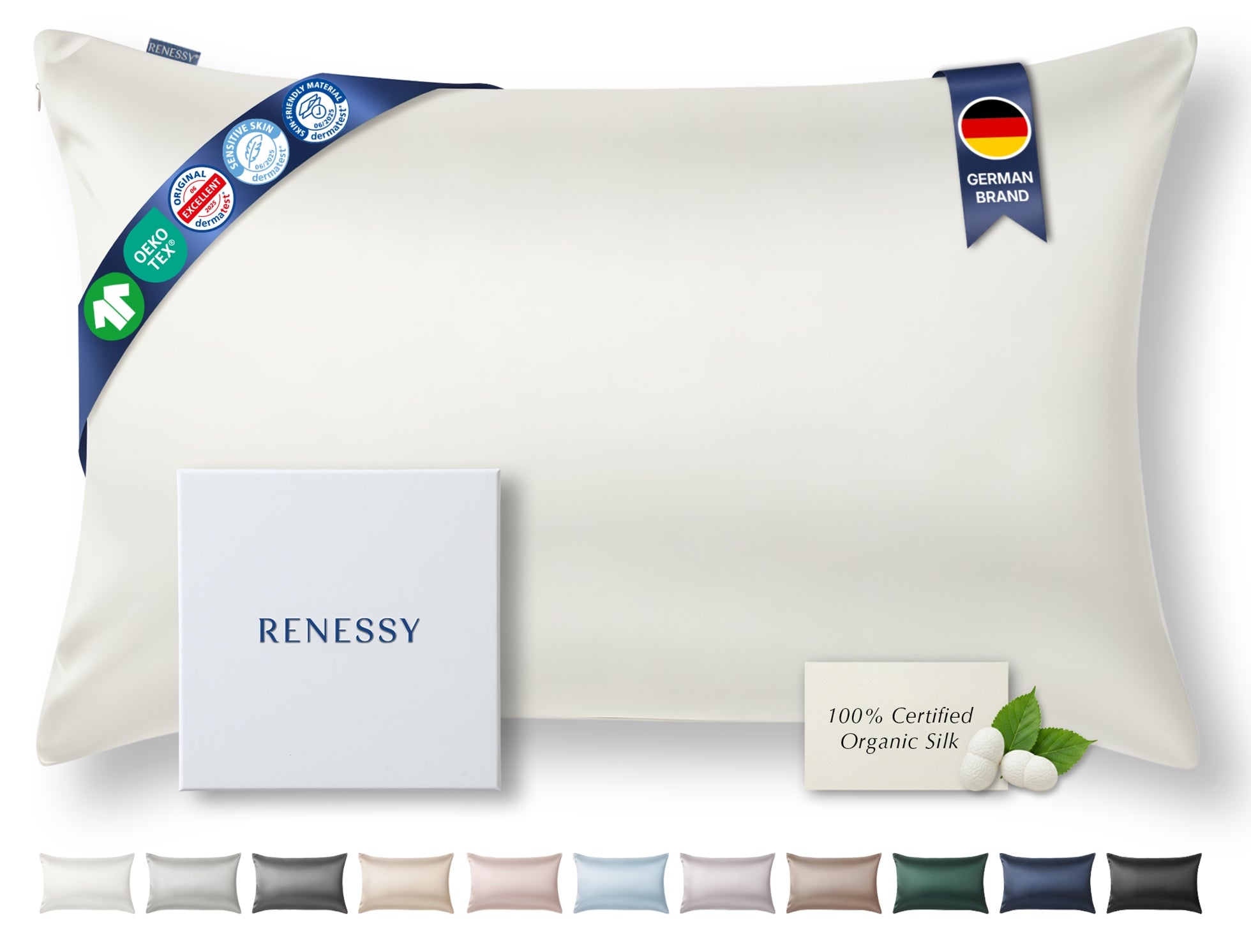
Our silk bonnet is made of 22 momme Grade 6A organic mulberry silk on both of its layers, so the silk is against your hair on the inside and is also what you see on the outside. The closure is an adjustable buckle band over an elastic woven edge. The silk is GOTS-certified, and the bonnet carries the OEKO-TEX MADE IN GREEN label. As with any bonnet, our rule of thumb is to put it on once your hair is towel-dry.
Frequently asked questions
Can you put wet hair in a bonnet overnight?
Not while it still drips. Squeeze and blot it first, until it gives up no more water when squeezed, and check that the roots do not feel wet. Our rule of thumb: hair that is only slightly damp can go under a bonnet for the night.
Will a bonnet on damp hair make your hair or the bonnet smell?
We found no study on either. What you can control is the bonnet itself: air it inside out in the morning, do not store it damp, and wash it as the care label says.
Can you wear a bonnet over leave-in conditioner?
Yes, once the hair is towel-dry. Product does not change our threshold; how wet the hair is does. Wash the bonnet more often if it picks up a lot of product.
Is a bonnet or a silk pillowcase better on damp nights?
Neither is a way to dry hair, so the threshold is the same for both. A bonnet keeps damp hair gathered while you move; with a pillowcase there is nothing to wear, but it keeps no style together. The full comparison is in our article on silk bonnet benefits.
Sources
- Robbins C, Kamath Y. Hair breakage during combing. III. The effects of bleaching and conditioning on short and long segment breakage by wet and dry combing of tresses. Journal of Cosmetic Science, 2007;58(4):477-484. PubMed 17728947
- Popescu C, Höcker H. Cytomechanics of hair: basics of the mechanical stability. International Review of Cell and Molecular Biology, 2009;277:137-156. doi:10.1016/S1937-6448(09)77004-2
- Gavazzoni Dias MF. Hair cosmetics: an overview. International Journal of Trichology, 2015;7(1):2-15. doi:10.4103/0974-7753.153450
- Nikogeorgos N et al. Nanotribological characterization of human head hair by friction force microscopy in dry atmosphere and aqueous environment. Biointerphases, 2010;5(2):60-68. doi:10.1116/1.3432462
- Lee Y et al. Hair shaft damage from heat and drying time of hair dryer. Annals of Dermatology, 2011;23(4):455-462. doi:10.5021/ad.2011.23.4.455
- American Academy of Dermatology: Tips for healthy hair
- Mayo TT, Callender VD. The art of prevention: It's too tight: Loosen up and let your hair down. International Journal of Women's Dermatology, 2021;7(2):174-179. doi:10.1016/j.ijwd.2021.01.019
- American Academy of Dermatology: Seborrheic dermatitis: Causes
- Borda LJ, Wikramanayake TC. Seborrheic dermatitis and dandruff: a comprehensive review. Journal of Clinical and Investigative Dermatology, 2015;3(2). doi:10.13188/2373-1044.1000019
- NHS: Dandruff
- Saunte DML, Gaitanis G, Hay RJ. Malassezia-associated skin diseases, the use of diagnostics and treatment. Frontiers in Cellular and Infection Microbiology, 2020;10:112. doi:10.3389/fcimb.2020.00112
- Chalupczak NV, Lipner SR. Malassezia folliculitis: an underdiagnosed mimicker of acneiform eruptions. Journal of Fungi, 2025;11(9):662. doi:10.3390/jof11090662
- Smithsonian Museum Conservation Institute: Mold and mildew on textiles
RENESSY · Updated September 2026