


Why Does My Hair Take So Long to Dry? Causes and What Helps
Why does my hair take so long to dry? Wet hair holds water between the strands and inside each swollen strand, and the water inside has to evaporate, so the more water your hair holds and the less it is reached by dry, moving air, the longer it takes. Length, density, a humid room and tied-up hair slow it down, and guides add thick strands and curls, while pressing out water, drying in loose sections and moving air speed it up.
How hair holds water
Wet hair holds water in two places. Some of it sits between the strands. In a 2003 lab study, researchers spun soaked hair in a centrifuge to strip off this “capillary water”, then treated what the hair still held as water absorbed by the fibres themselves. Squeezing and blotting are the everyday way of removing the water from between the strands; we found no study that measured how much of it a towel takes up.
The rest is inside the fibre. A 1987 review of hair research reports that in air at 65 per cent relative humidity (how much water vapour the air holds compared with the most it could hold at that temperature), hair takes up about 14.5 per cent moisture, held mostly in the protein matrix inside the fibre, and swells by about 16 per cent in diameter but only 1.2 per cent in length: a strand that takes up water grows mainly in width and only slightly in length. Water that has soaked into the fibre has to evaporate out of it.
Why your hair takes so long to dry
A standard reference text on evaporation from the UN Food and Agriculture Organization sets out three conditions. Turning liquid water into vapour takes energy, which warmth supplies. Evaporation is driven by the difference in water vapour between the wet surface and the surrounding air, so humid air slows it. And the air next to the wet surface gradually fills with vapour, so evaporation slows and can stop unless moving air replaces it with drier air. The text deals with soil and plants, not hair. For hair itself, a 2007 lab study found that, once hair had adjusted to the surrounding air, the water it held rose steadily with relative humidity between 40 and 85 per cent.
Most causes of slow drying come back to those three conditions:
- The amount of hair: more strands hold more water, and moving air hardly reaches the inner layers. High density hair needs more product to cover all of it, and it takes longer to dry. Density, the number of hairs on your scalp, is explained in our guide to hair density.
- Strand thickness: hair care guides agree that thick, coarse strands dry more slowly than fine ones; we found no study that timed the difference.
- Length: longer hair is simply more hair holding water.
- Curls: guides note that curls and coils hold water within their shape, which leaves less of the hair open to the air.
- Heavy product and build-up: according to hair care guides, both can slow drying.
- A humid or cold room: the air in a steamy bathroom already holds a lot of vapour, and a cold room supplies less warmth.
- Hair tied up or wrapped: the air inside a bun, under a clip or in a towel fills with vapour and is not replaced, so the covered layers dry more slowly.
Does porosity decide it?
Porosity, in hair care guides, describes how easily hair lets water in and out, and most of the guides we read say that low porosity hair dries slowest. Low porosity is a guide label, not a laboratory category. Hair care guides usually read hair that dries quickly as high porosity, and lab studies found that bleached hair loses water faster than untreated hair and that weathered hair loses it faster than intact hair.
For damaged hair, holding more water did not mean drying more slowly. In the 2003 centrifuge study, bleached hair held much more water than undamaged hair, yet in a 2022 study that followed heavy water through hair under an infrared microscope, the water left bleached hair about an hour sooner than untreated hair. We found no study that measured drying time by porosity type. Hair that dries fast may simply be short, fine or less dense; if it has been bleached, the lab findings above would also explain it. How to read your own hair's porosity is covered in our hair porosity test.
How long does it take for hair to dry?
There is no single honest figure for how long hair takes to dry, because it depends on length, density, strand thickness and the room, and we found no study that measured it on real heads. Online guides give drying times by hair type, but none of the pages we read cites a source for them. Some guides also say how dry hair should be as a percentage. We found no study behind any such percentage.
The one measured drying time we found comes from a 2011 lab study: a tress (a small bundle of cut hair used in lab tests) 20 cm (8 in) long and weighing 2 g, tapped gently with a towel to remove the drops, took more than 2 hours to dry at a room temperature of 20 °C (68 °F). That is a small lab tress, not a whole head. For bedtime, the squeeze test described below is more useful than any number.
Is it better to air dry or blow dry hair?
Neither is simply better: air-drying spares the hair any heat but leaves it wet for longer, and blow-drying shortens the wet stage but adds heat. In one lab study, hair dried with a dryer held 15 cm away and kept moving showed less damage over repeated washes than hair left to dry naturally; the authors called for more research.
The same 2011 study also measured the temperature just above the hair: it rose the closer the dryer was held, reaching 47 °C (117 °F) at 15 cm (6 in), 61 °C (142 °F) at 10 cm (4 in) and 95 °C (203 °F) at 5 cm (2 in), and the damage to the hair surface rose with the temperature. The naturally dried group showed no lifted or cracked cuticle on its surface, but it was the only group to show damage to the cell membrane complex, a layer inside the hair that swells in water; the authors speculated that long contact with water may be what harms it. The moisture content of the hair afterwards did not differ significantly between the drying groups.
Keep hot tools for occasional use and on a low setting, because repeated high heat leaves the strand dry and brittle. If you blow-dry, distance is what the study measured: the further away the dryer, the cooler the air at the hair stayed.
How to dry hair faster, with or without a blow dryer
How to dry hair fast comes down to removing as much water as you can and then letting dry, moving air reach all of the hair, and most of that needs no blow dryer.
- Squeeze, do not wring. One guide we read warns that wringing can stretch wet hair, and a 2015 review reports that wet hair that has not been chemically treated can be stretched by up to 30 per cent of its length without damage, but that stretching it further changes it irreversibly. What else leads to breakage is covered in our guide to hair breakage.
- Blot. The American Academy of Dermatology advises wrapping hair in a towel or T-shirt to absorb the water, because roughly rubbing hair dry can damage it. Guides often suggest a microfibre towel; we found no study that compared towel types.
- Then leave it loose rather than keeping it wrapped, and out of a bun or a clip, so that air reaches every layer.
- Work in sections. Styling guides advise small sections, starting at the nape and moving up towards the crown.
- If you use a dryer, some guides advise drying the roots first on medium heat.
- Choose a ventilated room rather than a steamy bathroom.
- Move the air: a fan, an open window or a dryer on a cool setting helps replace the humid air next to the hair.
Plopping is an exception to leaving hair loose: drying methods for curls, such as plopping and diffusing, are set out in our curly hair routine.
Still wet at bedtime?
We use two thresholds for “dry enough”: one for going to bed at all and a higher one for a blow-dry or straightened style. We suggest going to bed with hair at least towel-dry, meaning it no longer drips and gives up no more water when you squeeze it. How long that takes depends on hair length, density, how much water the hair is still holding and how dry the room is, which is why the squeeze test is a better guide than the clock. What a wet night means for hair and scalp is covered in our guide to sleeping with wet hair, and when a bonnet can go on in our guide to wearing a bonnet with wet hair.
For a blow-dry or straightened style, the bar is higher. Go to bed with hair completely dry, roots included: towel-dry hair is still damp and sets in whatever shape the pillow presses it into. Keeping a style overnight is covered in our guide on how to avoid bed head.
None of these makes damp hair dry sooner overnight:
- A towel turban. A turban holds moisture against the hair and scalp rather than letting it go.
- A silk pillowcase. It will not dry your hair faster: a densely woven silk fabric takes up less moisture than an absorbent cotton one, so more water stays in the hair, which for drying time is a drawback rather than a feature.
- A closed cap. Any closed cap slows drying, whatever it is made of, because the air inside it stays humid.
What the research does not tell us
We found no study that measured drying time by hair length, density or porosity type, and no study that compared towel types or rubbing with blotting. The only comparison of air-drying and blow-drying we found is one lab study on small tresses, and its authors asked for more research. The drying times by hair type that we found online come without sources.
What our silk pillowcases are made of
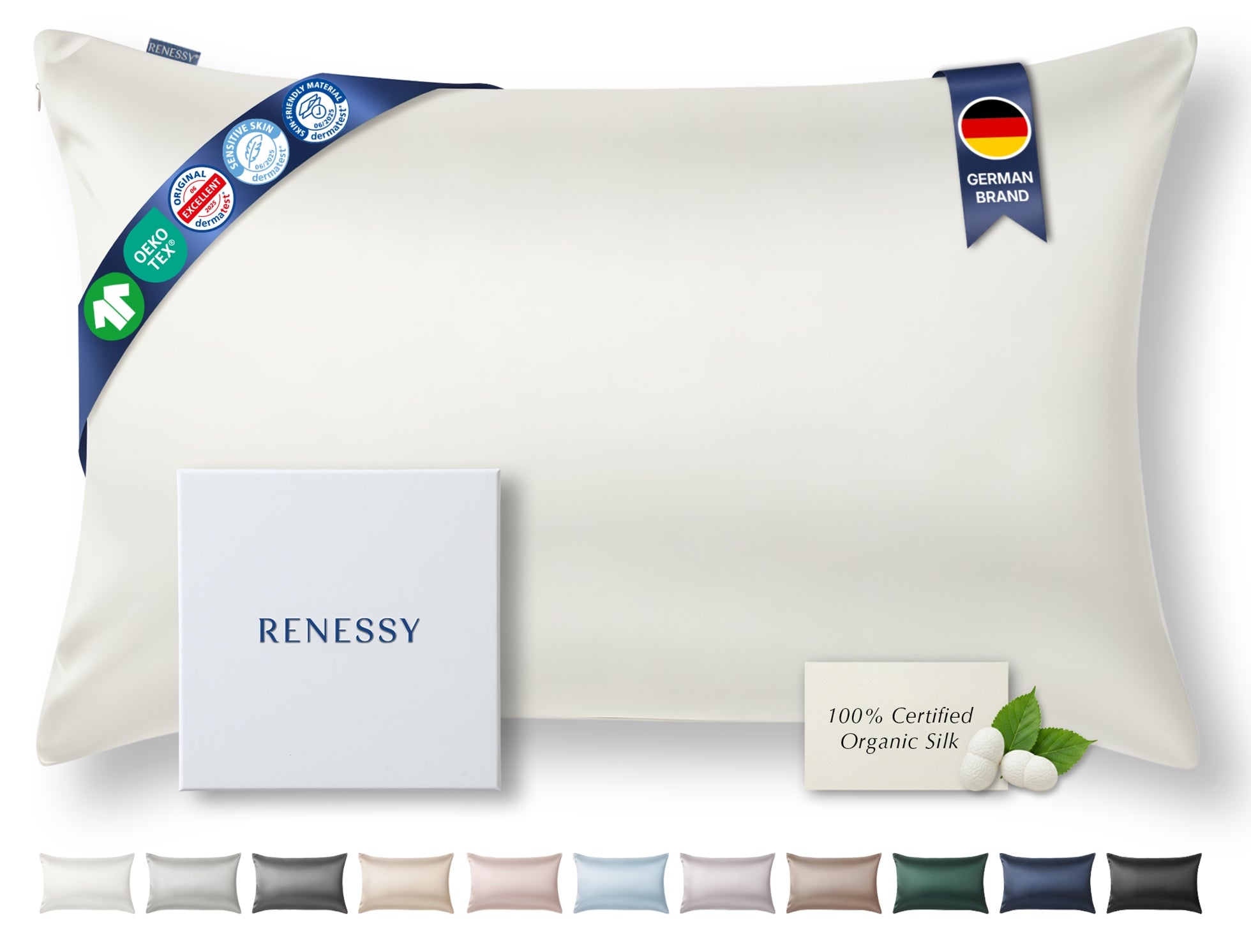
The RENESSY silk pillowcases use 100% organic mulberry silk with a weight of 22 momme, and both faces of each case are silk. Mulberry silk comes from silkworms raised on the leaves of the mulberry tree, and momme measures the weight of silk fabric. The raw silk is rated grade 6A, a raw-silk grade that assesses several qualities of the thread together. GOTS, the Global Organic Textile Standard, certifies textiles made from organically grown fibres. The silk is GOTS certified. OEKO-TEX MADE IN GREEN is a label for textiles tested for harmful substances and made in traceable, certified production. The pillowcases carry the OEKO-TEX MADE IN GREEN label, and the label ID M27MNB1V9 can be checked on the OEKO-TEX website. The pillowcases carry the Dermatest 5-Star seal and the Dermatest Sensitive Skin seal, dermatologically tested for sensitive skin. A hidden YKK zip closes each case.
Frequently asked questions
How long does it take for hair to dry?
How long it takes for hair to dry depends on its length, density, strand thickness and the room, and we found no study that measured it on real heads. The only measured figure we found comes from a 2011 lab study, in which a tress 20 cm (8 in) long and weighing 2 g took more than 2 hours to dry at 20 °C (68 °F).
Does low porosity hair take longer to dry?
Hair care guides say low porosity hair takes longer to dry, but that is a guide label rather than a measured result, and we found no study that timed drying by porosity type. For damaged hair, lab studies point the other way: bleached hair lost water faster than untreated hair, and weathered hair faster than intact hair.
Is it bad to blow dry your hair?
Blow-drying your hair is a trade-off rather than simply bad: it adds heat, while air-drying keeps hair wet for longer. In one 2011 lab study, damage to the hair surface increased as the dryer was held closer and the air at the hair got hotter, so if you blow-dry, keep the dryer at a distance.
How can I dry my hair without a blow dryer?
To dry your hair without a blow dryer, squeeze the water out, blot it with a towel or T-shirt, leave it loose, work in sections and let it dry in a room with fresh, moving air, such as from a fan or an open window. Avoid wringing it or keeping it wrapped in a towel.
Why does my hair take so long to blow dry?
Even with a dryer, the water inside each swollen strand has to evaporate, and so does any water left between the strands, so the more water your hair still holds, the longer blow-drying takes. Length, density and a humid room slow it down, and guides add thick strands and curls, while drying in loose sections speeds it up.
Sources
- Allen RG, Pereira LS, Raes D, Smith M. Crop evapotranspiration: guidelines for computing crop water requirements. FAO Irrigation and Drainage Paper 56. Rome: Food and Agriculture Organization of the United Nations; 1998. Chapter 1. fao.org
- American Academy of Dermatology. Tips for healthy hair
- Fuse N, Matsui M, Matsue Y. Temporal and spatial visualization of water uptake into human hair studied by infrared microscopy. Analytical Sciences. 2022;38(3):601-605. doi:10.1007/s44211-022-00074-x
- Gao T. Evaluation of hair humidity resistance/moisturization from hair elasticity. Journal of Cosmetic Science. 2007;58(4):393-404. PMID 17728940
- Gavazzoni Dias MF. Hair cosmetics: an overview. International Journal of Trichology. 2015;7(1):2-15. doi:10.4103/0974-7753.153450
- Jachowicz J. Hair damage and attempts to its repair. Journal of the Society of Cosmetic Chemists. 1987;38(4):263-286.
- Lee Y, Kim YD, Hyun HJ, Pi LQ, Jin X, Lee WS. Hair shaft damage from heat and drying time of hair dryer. Annals of Dermatology. 2011;23(4):455-462. doi:10.5021/ad.2011.23.4.455
- Piérard-Franchimont C, Piérard GE. Hair weathering and hair capacitance mapping: a pilot study. Journal of Cosmetic Dermatology. 2012;11(3):179-182. doi:10.1111/j.1473-2165.2012.00620.x
- Rele AS, Mohile RB. Effect of mineral oil, sunflower oil, and coconut oil on prevention of hair damage. Journal of Cosmetic Science. 2003;54(2):175-192. PMID 12715094